Imagine walking into a high-tech arcade where you don’t use your own quarters to play. Instead, a company hands you a big bag of tokens and says, “Go ahead, show us your skills!” If you win big, you get to keep a huge chunk of the treasure.
That is basically what proprietary trading or prop trading is for grown ups. People use a company’s money to trade things like stocks, currencies, or commodities in the global financial markets.
But here is the catch that nobody talks about until April rolls around:
The tax monster wants a piece of every single victory.
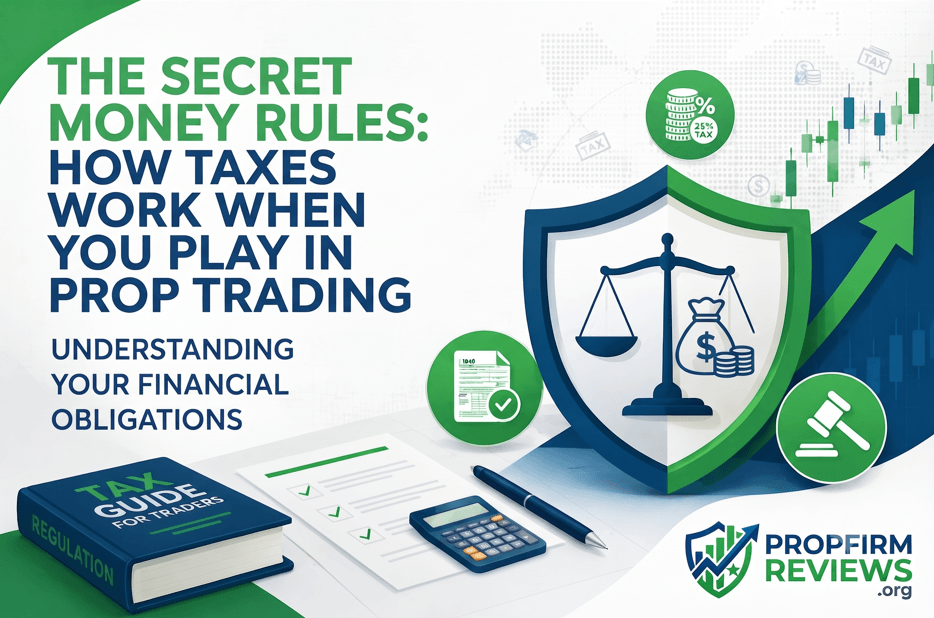
If you are trading with a prop firm, understanding taxes isn’t just boring paperwork it is the difference between keeping your hard earned cash or handing it all back to the government. Let’s break down how prop trading taxes work in prop trading so it makes total sense.
Quick Answer (Too Long, Didn’t Read)
- What are prop trading taxes? They are the taxes you must pay on the profits you make when trading with a funded account from a prop firm.
- Are you an employee? Nope! Most prop traders are treated as independent contractors or self-employed businesses, meaning you handle your own taxes.
- What gets taxed? Your net profits (what you made minus your expenses, like firm evaluation fees and platform subscriptions).
- The Golden Rule: Always keep detailed logs of every trade, fee, and payout. If you don’t track it, the taxman will guess and his guesses are never in your favour.
You Aren’t an Employee, You Are a Business
When most people get a job, taxes are automatically taken out of their paycheck. The boss handles it.
Prop trading doesn’t work that way. When you pass a prop firm’s evaluation and start receiving profit splits, you are legally viewed as an independent contractor or a sole proprietor.
Think of yourself like the owner of a tiny lemonade stand. The prop firm is like a supplier who gives you the lemons and sugar, but you are the one running the business.
Because you are your own boss:
- The prop firm will not withhold taxes from your payouts.
- You are responsible for calculating and paying your own income taxes and self-employment taxes.
- If you live in the United States, you might need to make estimated tax payments every three months instead of waiting until the end of the year.
Write-Offs: Turning Expenses Into Savings
Running a prop trading business costs money. You have to pay for evaluation fees, platform subscriptions, charting tools, and sometimes even fast internet or a second computer monitor.
The good news? These are business expenses.
Imagine you made five thousand dollars in profit splits this year, but you spent one thousand dollars on evaluation fees and software. You shouldn’t have to pay taxes on that spent thousand dollars.
By tracking your expenses carefully, you lower your taxable income. It is like getting a discount on your taxes just for keeping your receipts organized. Every time you buy a trading tool, save that digital receipt!
The Big Puzzle: Capital Gains vs Business Income
How your profits are taxed depends heavily on where you live and how your prop firm account is set up.
Some traders receive their payouts as regular business service fees (contractor income). Others trade through specific legal structures that might classify earnings differently.
- The Trap: A lot of beginner traders think, “Oh, I made money in the stock market, so these are capital gains taxes!” But with many online prop firms, you are actually getting paid a performance bonus or contractor split for providing analytical services, not trading your own personal capital.
- The Solution: Always check local tax laws in your country or state. A local accountant who understands online businesses and trading can save you thousands of dollars of mistakes.
Why Tracking Everything Keeps You Safe
Have you ever tried to build a giant Lego castle without looking at the instruction booklet? You end up with extra pieces and a wonky tower that falls over.
Tax season is the exact same way. If you don’t track your payouts and expenses as they happen, filing taxes becomes a nightmare.
Successful prop traders treat their record-keeping like part of their trading edge:
- Save every payout receipt from your dashboard.
- Keep a folder for every software subscription or educational tool you buy.
- Log your net earnings every single month.
When you stay organized, tax season goes from a terrifying monster to just another checklist item.
What Gaurav (Our Expert) says about this article:
Taxes can feel confusing, but they’re actually a big deal when you’re in prop trading! I went through this article myself to make sure everything here is correct and easy to understand no boring jargon. Think of it as your simple guide to staying on the tax monster’s good side. Just remember, a real accountant can help with your exact situation. Trade smart. – by Gaurav Kashyap
Wrapping Up
Prop trading is an exciting journey that tests your patience, strategy, and mental strength. But making money is only half the battle keeping it is the other half.
By treating your prop trading like a real business, saving your receipts, and preparing for tax obligations before they sneak up on you, you keep yourself safe and sound.
What is the coolest trading strategy you have ever tested out?

Hey, I’m Gaurav Kashyap. With a background in market infrastructure and FX, I love looking under the hood of proprietary trading platforms. Let’s be real—finding a reliable prop firm with fair rules can be a headache. I write reviews to simplify the fine print, call out bad terms, and point you toward funding programs that actually treat traders right.