
Equity vs. Balance Drawdown: The Reset Calculation That Blows Accounts
Getting funded feels like the finish line. It isn’t. Keeping the account alive depends on understanding exactly how the server-side risk system watches your equity, and among all the funded account drawdown rules, nothing quietly ends more accounts than the daily loss limit. Traders don’t usually blow this one by losing too much money in a single session — they blow it by not knowing there are two completely different ways a firm can calculate that limit: an equity vs balance drawdown.
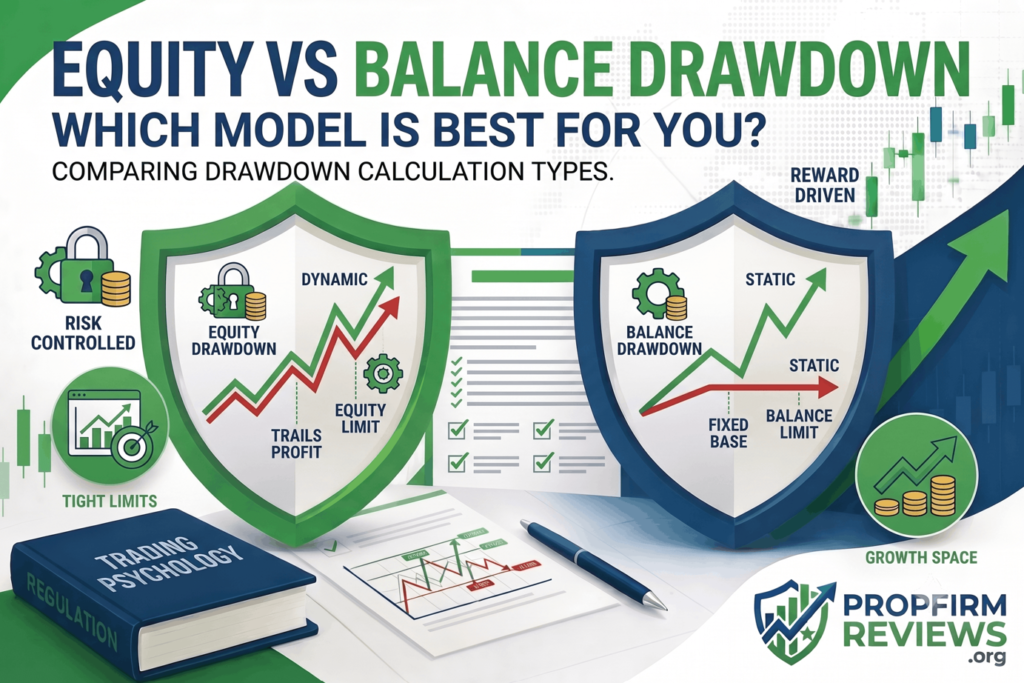
A balance-based daily drawdown calculates your maximum loss threshold using only your closed, settled cash balance at the moment of the daily server reset. An equity-based daily drawdown calculates that same threshold using your live, floating equity — including any open unrealized profit or loss — at that reset moment. Under the equity model, any open floating profit still sitting there when the reset hits gets baked into your new baseline, which instantly pushes your daily loss floor higher than you’d expect.
Not knowing which model your firm runs can end a funded account in a fraction of a second, with zero warning. Here’s exactly how the math works, and how to trade around the daily reset without walking into it blind.
The Mathematics of the Daily Reset Engine
Prop firm servers run on a strict 24-hour clock. The prop firm daily reset time almost universally lands at 5:00 PM EST (New York time) — not by coincidence, but because that lines up with the daily close of the CME and the broader global forex settlement window.
At that exact moment, the risk engine takes a snapshot of your account and uses it to set your hard liquidation floor for the next 24 hours. Which formula it uses — balance or equity — completely changes how safe (or exposed) you are heading into the next session.
1. The Balance-Based Daily Reset Formula
This is the friendlier of the two models. At 5:00 PM EST, the system doesn’t care what your open trades are doing — it only looks at your finalized, closed cash balance.
$$\text{Next Day’s Daily Loss Floor} = \text{Closed Cash Balance at 5:00 PM EST} – \text{Allowed Daily Drawdown Amount}$$
So on a $100,000 account with a 5% daily limit ($5,000), if your closed balance reads exactly $100,000 at the reset, your floor for the next day is $95,000. It genuinely doesn’t matter whether you’ve got a trade floating at +$3,000 or -$1,000 at that moment — the number is anchored purely to settled cash.
2. The Equity-Based Daily Reset Formula (The Floating Trap)
This model is a lot less forgiving, and it’s the one that blindsides swing traders specifically. Here, the engine pulls in your live, open unrealized floating equity as part of the calculation.
$$\text{Next Day’s Daily Loss Floor} = \text{Floating Equity at 5:00 PM EST} – \text{Allowed Daily Drawdown Amount}$$
Same $100,000 account, same 5% limit — but this time you’ve got an open trade floating at +$4,000 right as the reset hits. Your equity in that moment is $104,000, and the engine snapshots that higher number, setting your next day’s floor at $99,000 ($104,000 minus $5,000).
Head-to-Head: Balance vs. Equity Reset Behavior
| Evaluation Metric | Balance-Based Daily Reset | Equity-Based Daily Reset |
|---|---|---|
| Reset Baseline | Fixed to settled cash balance at 5 PM EST | Fixed to live floating equity at 5 PM EST |
| Holding Floating Profit Past 5 PM | Safe — doesn’t affect the next day’s loss floor | Risky — permanently drags your daily loss floor higher |
| Sudden Reversals Post-Reset | You keep your full daily percentage buffer | Your buffer shrinks by the size of the unrealized pullback |
| Best Suited For | Swing traders, overnight holders, trend followers | Ultra-short-term scalpers and strict day traders |
One nuance worth knowing before you sign up: some firms don’t advertise which model they use anywhere in their FAQ — it’s often buried in the “risk management” clause of the funded trader agreement, sometimes under a term like “trailing daily equity stop.” If a firm’s marketing page is vague about it, that’s usually a sign it’s an equity-based reset, since balance-based firms tend to lead with that as a selling point.
The 5:01 PM Equity Reversal Catastrophe
Here’s exactly how this plays out in real time on an equity-based account:
- 4:59 PM EST: Your account balance is $100,000. You’re holding a long position on US30 floating at +$4,000. Live equity: $104,000.
- 5:00 PM EST (The Snapshot): The server resets. Because this firm uses an equity-based model, it logs your baseline at $104,000. Your daily loss floor for the next session locks in at $99,000 ($104,000 minus the $5,000 limit).
- 5:05 PM EST (The Pullback): The new session opens and pulls back slightly. Your position drops from +$4,000 down to +$3,000. Current equity: $103,000.
- The Breach Metric: Your closed cash balance is still sitting at a healthy $100,000. But your equity has fallen $1,000 from the snapshot peak, which means your actual distance to the daily floor has shrunk by the same amount. Give back another $4,000 from here and equity hits $99,000 — triggering a full daily breach, even though your cash balance never dropped a single dollar below where you started.
That last detail is the part that trips people up hardest: your account statement can look completely fine — balance positive, no losing trades closed — while the risk engine has already quietly moved you to the edge.
Strategic Game Plan: Managing the Reset
If your firm uses Equity-Based Resets: Flatten your positions before 5:00 PM EST, full stop. Don’t leave meaningful floating profit open through the reset — doing so effectively hands the firm your own peak numbers to use as ammunition against your risk buffer the next day.
If your firm uses Balance-Based Resets: You’re free to swing trade and hold overnight, just make sure you’ve separately checked the platform’s weekend holding prop firms rules first, since a friendly daily reset model doesn’t automatically mean weekend gap protection.
Frustrated by Floating Equity Reset Traps?
If your trading style depends on holding positions across sessions, a back-office script shouldn’t be the thing that ends your account. Look for platforms that track pure cash balances instead. Our Topstep review breaks down how their futures accounts actually handle intraday execution, and our deep-dive on static vs trailing drawdown structures covers how to build a risk buffer that doesn’t move against you.