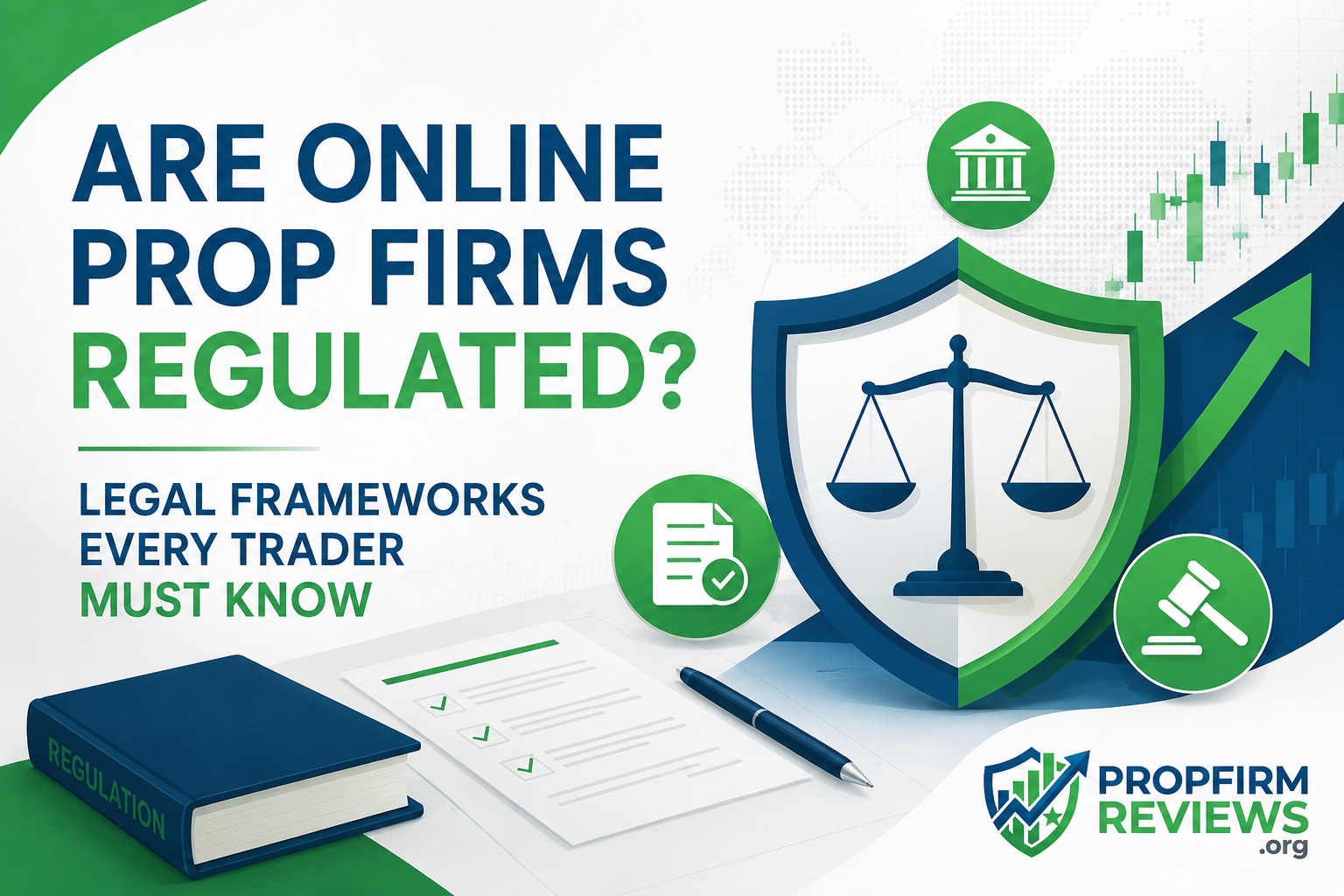
So… Are Online Prop Firms Actually Regulated?
Okay, let’s start simple.
Imagine you want to open a lemonade stand. But instead of using your own pocket money to buy lemons, someone else gives you the money and says: “Here, use this. If you make a profit, we split it.”
That’s basically what a prop firm does — except instead of lemonade, you’re trading currencies, stocks, or futures.
Now here’s the big question: Is there a referee watching to make sure everyone plays fair?
The honest answer? For most online prop firms — not really. And that’s exactly what this article will help you understand.
⚡ Quick Take: Are Prop Firms Regulated?
No. Most online prop trading firms operate as evaluation platforms using simulated demo accounts, rather than traditional asset managers. Because you are trading the firm’s simulated capital rather than investing your own or client funds, global watchdogs do not formally license most prop firms. However, stricter enforcement regarding financial promotions, consumer protection, and tax compliance is rolling out rapidly.
What Even Is a “Regulated” Company?
When a company is regulated, it means a government body — like a financial watchdog — is keeping an eye on it. Think of it like a school principal. The principal makes sure everyone follows the rules, and if someone misbehaves, there are real consequences.
For banks and traditional brokers, these watchdogs exist everywhere:
-
United Kingdom: FCA (Financial Conduct Authority)
-
United States: CFTC (Commodity Futures Trading Commission) and SEC (Securities and Exchange Commission)
-
South Africa: FSCA (Financial Sector Conduct Authority)
-
Australia: ASIC (Australian Securities and Investments Commission)
These organizations enforce strict financial compliance to make sure companies:
-
Keep your money safe in segregated accounts.
-
Maintain clear anti-money laundering (AML) and know-your-customer (KYC) protocols.
-
Tell you the absolute truth about fees and performance risks.
-
Provide a formal legal avenue for consumer complaints if something goes wrong.
The problem? Most online prop firms don’t have any of this.
Why Are Prop Firms Not Regulated Like Banks?
Here’s where it gets interesting.
Regulators were built to protect retail investors whose own money is at risk. But prop firms utilize a clever defense. They argue: “We’re not managing your money — we’re providing closed-loop, synthetic pricing on a simulated server and letting you trade our capital.”
Because of this regulatory arbitrage, most prop firms slip through the cracks. The regulators look at them and say, “Technically, no live investor deposits are being managed here,” and walk away.
It’s a bit like a game where the rules were written before this type of business even existed. The rulebook hasn’t caught up yet. So, most prop firms operate in a legal grey area — which means they’re not exactly illegal, but they’re not exactly being watched either.
How Does This Work in Different Countries?
Let’s do a quick tour around the world, keeping it simple.
🇺🇸 United States
No specific rulebook for evaluation-based prop firms exists yet. However, the regulatory gap is closing fast. Following high-profile court cases, the CFTC is actively moving to classify evaluation prop firms as CTAs (Commodity Trading Advisors) if they offer futures trading. Most forex prop firms operate freely, though many have shifted their corporate structures abroad to completely avoid US jurisdiction.
🇬🇧 United Kingdom
The FCA is paying incredibly close attention. Through multi-firm reviews, they are cracking down under Section 21 of FSMA (Financial Promotions), targeting firms that push misleading “easy funding” social media ads. The FCA believes that if a firm collects a challenge fee from you, it impacts retail consumers and needs strict guardrails.
🇪🇺 European Union
Europe has incredibly strict rules for investment companies under a massive framework called MiFID II. Prop firms historically argued these rules don’t apply to simulated environments. However, EU regulators are actively pushing back against “gamified” retail investing, putting intense pressure on prop firm marketing and execution models.
🇿🇦 South Africa
The FSCA has been one of the most proactive watchdogs. They’ve explicitly stated that any firm offering financial derivatives to South African citizens — even an overseas platform operating online — requires a specific financial services license.
🇦🇺 Australia
ASIC is incredibly tough. They regularly pursue unlicensed entities offering financial products to citizens. Because of this aggressive stance, prop firms targeting Australian traders face massive legal risks, meaning Aussie traders actually have a slightly tighter structural safety net than most.
Evaluation Prop Firms vs. Regulated Brokers
To help you see the difference clearly, here is how a typical online prop firm stacks up against a traditionally regulated broker:
| Feature | Regulated Broker | Evaluation Prop Firm |
| Primary Regulator | FCA, ASIC, SEC, etc. | None (Operates under standard corporate/contract law) |
| Capital at Risk | Your personal trading balance | Only your initial evaluation/challenge fee |
| Trading Environment | Live market liquidity providers | Simulated demo servers / Synthetic pricing |
| Account Protection | Government-backed insurance schemas | None (Subject to firm’s internal payout liquidity) |
| Compliance Load | Strict KYC, AML, and capitalization rules | Basic identity verification before payout |
What Does a “Good” Prop Firm Look Like?
Even without official financial regulation, the best prop firms try to do things the right way. Here’s what a trustworthy, operationally stable firm looks like:
-
Verifiable Corporate Entity: They openly show where the company is legally registered so you can look up their business filing yourself.
-
Transparent Drawdown Logic: Their rules are crystal clear. No hidden consistency clauses or sneaky overnight rules buried in the fine print.
-
Operational Track Record: They have a multi-year history (ideally 2 to 3+ years) of consistent, verified payouts backed by a large, transparent trader community.
-
Regulated Broker Partnerships: Even if the prop firm isn’t regulated, the underlying brokerage or liquidity platform they plug into is.
-
Strict Audit Trails: They use automated rule engines to judge accounts fairly, meaning they don’t manually alter your trading conditions when you start winning.
Think of it like buying something second-hand. It might not come with a manufacturer’s warranty, but if the seller has thousands of verified reviews and a transparent history — that’s a good sign.
Red Flags That Should Make You Run
Now for the scary part. The lack of a referee means some bad actors exploit the system. Watch out for these warning signs:
-
No Physical Address: If you can’t find a real, verifiable corporate headquarters anywhere on their site, close the tab.
-
Vague Withdrawal Terms: If their terms say they can deny a payout for “unspecified toxic strategies” at their sole discretion, be very careful.
-
Guaranteed Returns: If an ad promises guaranteed profits or tells you that passing is “easy,” walk away. Nobody can guarantee market returns.
-
Hyper-Aggressive Social Media Tactics: Legit firms rely on their execution track record; shady firms rely on flashy lifestyle marketing and high-pressure discount codes.
-
Sudden Account Closures: Check forums to ensure the firm doesn’t systematically ban profitable traders right before a major payout milestone.
So If Something Goes Wrong, What Can You Do?
Even without a financial watchdog protecting you, you’re not totally helpless. You still have a few vital tools in your corner:
-
Contract Law: When you purchase an evaluation, you sign a digital Terms of Service agreement. If a firm breaks its own written rules or refuses a contractually valid payout, they are breaching a legal contract. Depending on where they are registered, you can pursue legal or corporate mediation.
-
Credit Card Chargebacks: If you paid your challenge fee via credit card and the firm completely disappears, changes the rules mid-challenge, or fails to deliver the service promised, your bank can step in via a commercial chargeback.
-
Consumer Protection Frameworks: In many jurisdictions, even non-financial companies are bound by strict fair-trading and e-commerce consumer laws. You can report predatory practices to local consumer courts.
-
Peer Warning Systems: Online trader forums, Discord channels, and independent review platforms act as an aggressive early warning system. Shady firms cannot hide from a bad reputation for long.
Frequently Asked Questions
Q: Is it legal for me to trade with an online prop firm?
In almost every country, yes. As a trader, the legal and tax responsibility of offering the service sits entirely on the firm, not you.
(Note: If you are trading from a country with strict foreign exchange laws, like India, make sure to look closely at local RBI and FEMA regulations regarding overseas outward remittances for digital platforms).
Q: Can I lose more money than my challenge fee?
Usually, no. Because you are trading on a simulated account, you cannot drop into a negative balance that you owe out of pocket. Your financial risk is strictly capped at whatever you paid to buy the evaluation.
Q: Are any online prop firms directly FCA regulated?
Almost none have direct FCA financial services registration, because they don’t hold retail deposits. You can always check the official financial registers (like register.fca.org.uk) to verify if a platform is a licensed broker or an unregulated corporate entity.
Q: How do I know if a prop firm is trustworthy?
Look for operational longevity. Choose firms that have survived market shakeouts, look up their physical company registration, study their drawdown mechanics, and cross-reference independent trader communities for structural payout patterns.
Q: Will prop firms ever be regulated properly?
Almost certainly, yes. Regulators globally are actively catching up. Over the next few years, expect to see standardized risk disclosures, mandatory AML frameworks, and clear definitions separating simulated and live execution models across the entire industry.
The Bottom Line
Most online prop firms are not officially regulated — meaning there’s no financial referee blowing a whistle if they break the rules. That doesn’t mean they’re all bad. Plenty of legitimate, operationally sound prop firms exist.
But it does mean you have to be your own referee. Check the company registration. Read the drawdown rules. Start small, track your data, and never pay more in challenge fees than you are genuinely okay with losing. The rules around prop firms are getting tighter every year. Until the law fully catches up, the smartest protection you have is your own common sense.
Disclaimer: This article is for educational and informational purposes only and does not constitute formal financial, tax, or legal advice. Always check the current local regulations in your country before purchasing an evaluation with any online trading platform.

I’m Tushar Gupta, a Research Analyst and trader specializing in Gold, Silver, and Forex. I founded my trading community to provide transparent, research-backed market analysis and risk management skills. My mission is to help you build the discipline needed to succeed without the market hype.