
Static vs. Trailing Drawdown: The Math That Determines Your Funded Success
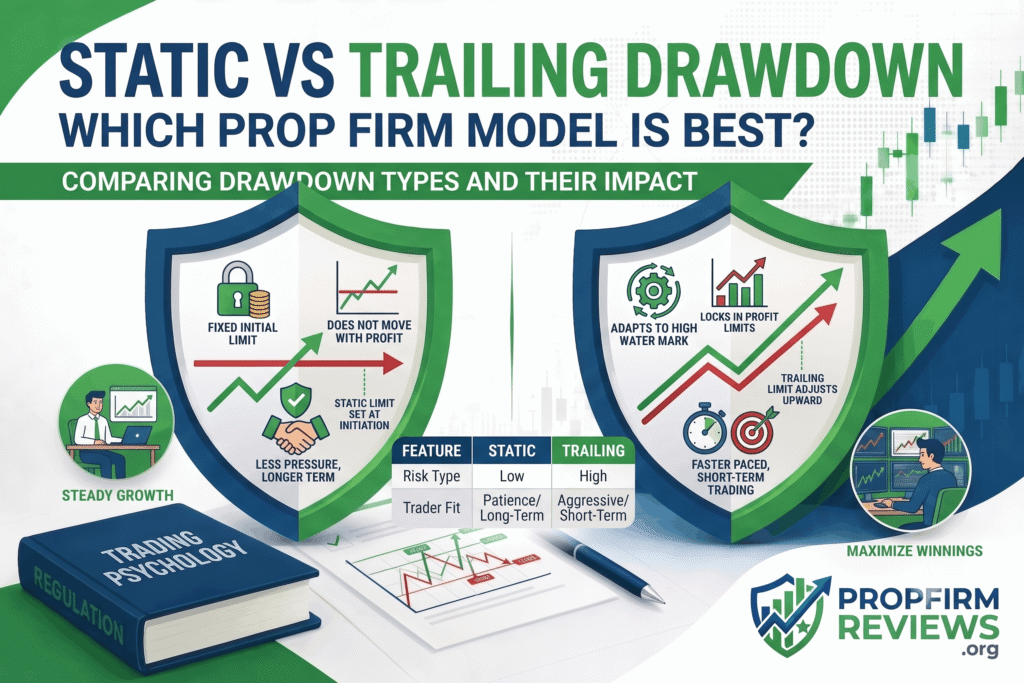
Most traders shopping for a prop firm challenge fixate on two numbers: the profit target and the profit split. Fair enough — those are the headline stats. But the number that actually decides whether you get paid or get breached rarely shows up in the marketing copy at all. It’s a quiet back-office setting called the drawdown model, and the difference between a static vs trailing drawdown is arguably the single biggest lever in the entire evaluation.
A static drawdown is a fixed risk parameter — the account’s maximum loss floor is set once, based on the starting balance, and never moves again. A trailing drawdown is a dynamic risk parameter that climbs alongside the account’s peak unrealized floating equity. Once that floor moves up, it stays there permanently — it does not retreat, even if the trade that pushed it up later gives back all of its gains.
Not understanding how these two models track your live execution is a big part of why more than 90% of evaluation attempts end in an automated breach. Below is exactly how the math works, how the tracking engines calculate it tick by tick, and how to keep it from quietly eating your buffer.
Technical Deep Dive: How the Tracking Engines Calculate Loss
Prop firms don’t have a human watching your account. They run server-side risk software — think Rithmic, Tradovate Admin, or a MetaTrader Manager bridge — that recalculates your risk boundary on every single incoming price tick. That real-time recalculation is exactly where the two models start to diverge, and it’s a bigger gap than most marketing pages let on.
1. Static Drawdown Mechanics (The Fixed Floor)
A static drawdown — sometimes called a relative drawdown vs. fixed floor, depending on which firm’s glossary you’re reading — is the more transparent of the two. Your loss floor gets calculated once, at account creation, and it just sits there.
$$\text{Static Loss Floor} = \text{Starting Balance} – \text{Maximum Allowed Drawdown}$$
Say you open a $100,000 account with a 5% static drawdown, which is $5,000. Your liquidation floor is set at $95,000 — permanently. It doesn’t matter if your balance climbs to $105,000 or $120,000 later; the account only breaches if your total equity drops below that original $95,000 line. Practically speaking, this means every dollar of profit you bank widens your actual safety margin over time.
2. Trailing Drawdown Mechanics (The Moving Goalpost)
A trailing drawdown works more like a one-way ratchet. The risk engine is constantly watching your peak unrealized floating equity — not your closed balance — and every time a trade pushes that peak higher, the loss floor gets dragged up with it.
$$\text{Trailing Loss Floor} = \text{Peak Unrealized Equity} – \text{Maximum Allowed Drawdown}$$
Take that same $100,000 account, but now with a 5% trailing drawdown. Your floor also starts at $95,000. But say you open a trade that floats up to +$4,000 in unrealized profit — your equity briefly touches $104,000. Even though you never closed that position, the engine has already recalculated your floor to $99,000 ($104,000 minus $5,000).
Now the market reverses and you close the trade flat, right back at $100,000 balance. Your floor doesn’t reset — it’s still locked at $99,000. You’re left with only $1,000 of breathing room before a full breach, despite never having actually banked a single dollar of profit.
Head-to-Head Comparison: Operational Impact
| Execution Metric | Static Drawdown Model | Trailing Drawdown Model |
|---|---|---|
| Loss Floor Behavior | Fixed permanently at account creation | Moves up with peak floating equity; never moves back down |
| Impact of Open Floating Profit | Zero effect on your maximum risk floor | Pulls the liquidation floor higher in real time |
| Buffer Building | High — growing the account directly widens your safety net | Low — the safety net stays a fixed distance away until you hit target |
| Strategy Compatibility | Ideal for swing trading, scaling in, and wider targets | Requires fast scalping or strict intraday exits |
| Common Platforms | Mostly seen in advanced forex setups and select futures options | The standard for most high-volume futures firms |
One thing worth flagging that often gets glossed over: some firms blend the two, applying a trailing drawdown only up to a certain equity milestone and then converting to static once you’ve banked enough profit. If you’re comparing firms, it’s worth asking support directly whether the drawdown model ever “locks in” — that single question can save you from a nasty surprise three weeks into a challenge.
The Unrealized Equity Trap: A Real-World Example
Here’s exactly how this plays out in practice, step by step:
- Account Open: Balance is $50,000. Maximum trailing drawdown allowed is $2,000. Initial liquidation floor: $48,000.
- Trade 1 Executed: You go long on gold. The position floats up to +$1,500, pushing account equity to $51,500. The risk engine instantly recalculates your floor to $49,500.
- The Reversal: A high-impact macro release hits and the market snaps back. You exit manually with a small locked-in profit of +$200.
- The Current State: Your closed cash balance now sits at $50,200. Your liquidation floor, though, is still frozen at $49,500.
- The Result: Your account balance is green, but your actual available risk capital has shrunk from $2,000 down to just $700 ($50,200 minus $49,500). One ordinary losing trade after this and the account is done.
This is the exact mechanic that catches experienced traders off guard, not just beginners — because the account “feels” fine on the balance line while the real risk buffer has already quietly evaporated.
Strategic Verdict: How to Trade Each Model
The drawdown model you’re assigned should shape your entire execution style, not just sit in the background:
Trading under a Trailing Drawdown: Don’t let winners float unchecked, and be cautious with wide trailing stops. You’re better off using firm, all-or-nothing profit targets, capturing quick momentum moves, and closing out positions decisively once you’ve hit your number — before the floor has a chance to ratchet up on you mid-trade.
Trading under a Static Drawdown: You’ve got real structural room here. You can hold through normal chop, scale into positions gradually, and let a genuinely strong trade run without worrying that an unrealized spike is quietly narrowing your safety margin behind the scenes.
If longevity is the actual goal — not just passing one challenge but keeping the account funded for months — leaning toward the best static drawdown prop firms is generally the more forgiving, mathematically sound path.
Looking to Avoid Moving Drawdown Floors?
If dynamic trailing parameters keep costing you evaluation accounts, it’s worth comparing platforms directly rather than guessing from marketing pages. Our independent review covers how their static tracking model holds up in practice, and our roundup of top balance-based evaluation platforms breaks down which firms let you trade against a fixed, non-moving safety net.