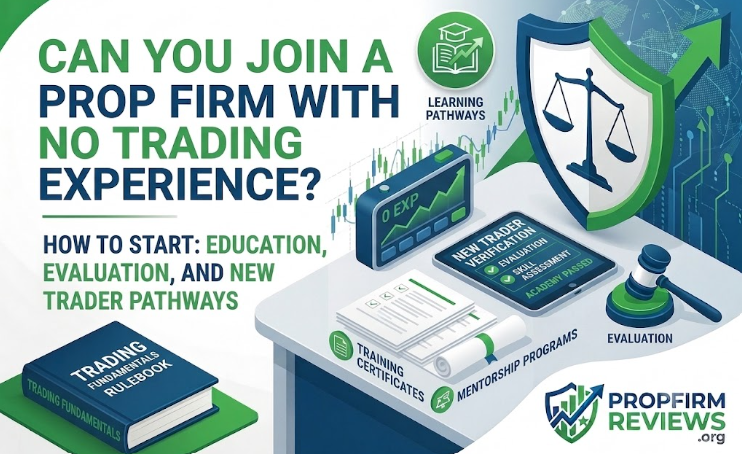
Yes, you can join a prop trading firm with no prior trading experience. Most proprietary trading firms don’t ask for a resume, a finance degree, or a track record before letting you attempt their evaluation.
What they actually care about is whether you can pass a challenge that tests risk management and consistency, not whether you’ve spent five years on a trading desk. That said, “allowed to join” and “likely to succeed” are two very different things, and the gap between them is where most beginners lose money.
This article breaks down exactly what prop firms require, why experience isn’t the real barrier, and what beginners need to do before risking their first evaluation fee.
What Is a Prop Firm, in Plain Terms
A proprietary trading firm gives traders access to its capital instead of their own. You pay a fee to attempt an evaluation (sometimes called a challenge), trade a demo or simulated account under specific rules, and if you hit the profit target without breaking the risk limits, you get funded. From there, you trade the firm’s money and keep a share of the profits, often 70-90%.
Firms like FTMO, Topstep, and dozens of newer entrants built this model specifically to widen the funnel. They don’t need your CV. They need you to prove, through actual trades, that you won’t blow up their account.
Why No Experience Isn’t a Dealbreaker
Prop firms make money largely from evaluation fees, and a smaller cut from profit splits with traders who pass. Their business model depends on volume, which means the sign-up process is intentionally accessible. There’s no interview, no background check on trading history, and no minimum years of experience listed anywhere in their terms.
This is different from traditional prop trading desks or hedge funds, which do hire based on credentials, math olympiad scores, or CFA charters. Retail-facing prop firms operate on a completely different model: the evaluation itself is the filter. If you can pass it, you’re in.
The Real Barrier Isn’t Eligibility, It’s the Evaluation
This is the part beginners underestimate. Passing an evaluation isn’t about knowing what a candlestick is. It’s about consistently managing risk under rules like:
- A maximum daily loss limit (often 4-5% of account size)
- A maximum overall drawdown limit (often 8-10%)
- A profit target to hit within a set number of trading days
- Minimum trading day requirements, so you can’t pass in one lucky session
Industry data consistently shows that the majority of prop firm challenge attempts fail, and most failures come from rule violations, not from an inability to find profitable trades. A trader who has never opened a chart before can still pass if they follow strict risk parameters. A trader with three years of experience can fail in a day if they revenge-trade after a loss.
In other words, the skill being tested is discipline, not market prediction.
What You Actually Need Before Signing Up
If you’re starting from zero, don’t jump straight into a paid challenge. Build this foundation first:
1. Learn the mechanics, not just the theory. Understand how leverage, lot sizes, spreads, and margin work on the specific platform the firm uses, whether that’s MetaTrader 4/5, cTrader, or a proprietary platform.
2. Practice on a free demo account first. Every serious broker offers this. Trade a demo for at least a few weeks before paying for any evaluation. This is where you find out if you can follow your own rules when there’s no money on the line yet, which is a different skill than trading with real stakes.
3. Write down a simple trading plan. Entry rules, exit rules, maximum risk per trade, and a daily loss limit you set for yourself, tighter than the firm’s limit. Beginners who survive evaluations almost always trade smaller than the maximum allowed risk.
4. Understand the specific firm’s rules cold. Read the terms twice. Some firms disqualify you for holding trades over the weekend, using news-based strategies, or copy-trading. Losing a challenge because you didn’t read the fine print is a common, entirely avoidable mistake.
5. Start with a smaller account size. A $10,000 or $25,000 evaluation costs less to attempt than a $100,000 one, and the dollar-value mistakes are smaller while you’re still learning your own psychology.
Common Mistakes Beginners Make
Most failed attempts trace back to a handful of repeatable errors: risking too much per trade because the account “isn’t real money yet,” trying to hit the profit target too fast instead of pacing across the allowed days, doubling down after a loss to “win it back,” and skipping a written plan entirely and trading on impulse. None of these require market experience to avoid. They require self-control, which is exactly why beginners with strong discipline sometimes outperform experienced traders with bad habits.
Do You Need Any Certification or License?
No. Prop firm evaluations are not regulated like financial advising or brokerage licensing. You don’t need a Series 7, a finance degree, or any formal qualification. The firm’s only real requirement is usually that you’re of legal age in your jurisdiction and can complete identity verification (KYC) once you pass, since payouts require it.
How Long Realistically Before a Beginner Is Ready?
There’s no universal timeline, but a reasonable, honest estimate for someone starting completely fresh is two to four months of demo practice and study before attempting a paid evaluation. That’s not a hard rule. Some people move faster if they’re disciplined and treat demo trading seriously instead of gambling with fake money. Others need longer. The mistake is rushing the timeline because the sign-up form didn’t ask you to wait.
Frequently Asked Questions
Do prop firms check trading history before letting you join? No. There’s no application review of past trades. Anyone who pays the evaluation fee can attempt the challenge.
Can a complete beginner pass a prop firm challenge? Yes, it happens regularly. Passing depends more on risk discipline and rule-following than on years of market experience.
Is it risky for a beginner to pay for an evaluation right away? It can be, mainly because most beginners fail their first attempt and lose the fee. Practicing on a free demo account first reduces that risk significantly.
What skill matters most for passing, if not experience? Risk management. Staying within daily and overall drawdown limits matters more than picking winning trades.
Do you need a finance background to get funded? No. Funded traders come from every background. The evaluation, not a resume, decides who gets funded.
The Bottom Line
Prop firms don’t gatekeep on experience, they gatekeep on performance under their specific prop firm rules. That’s genuinely good news for beginners, but it also means the responsibility shifts entirely onto you to build the discipline before you spend money on an attempt. Learn the platform, practice on a demo, write a real trading plan, and trade smaller than you’re allowed to. Experience isn’t the requirement. Preparation is.

I’m Tushar Gupta, a Research Analyst and trader specializing in Gold, Silver, and Forex. I founded my trading community to provide transparent, research-backed market analysis and risk management skills. My mission is to help you build the discipline needed to succeed without the market hype.