
Prop Firm Rules Explained: The Ultimate Guide to Risk & Payout Compliance
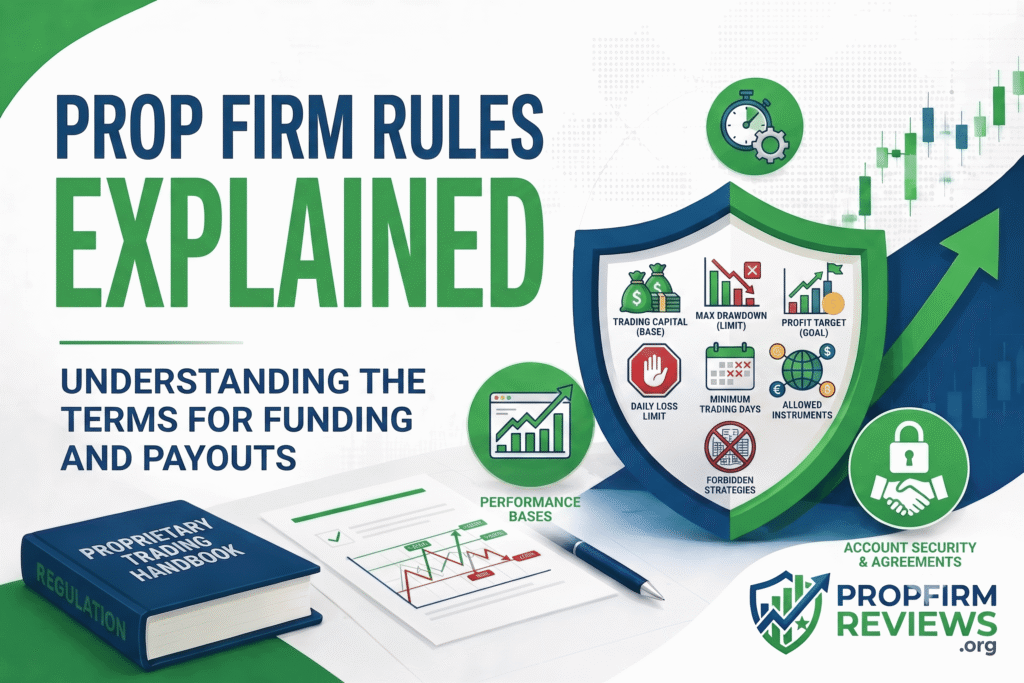
If you’ve ever failed a prop firm challenge and thought “but my strategy was profitable,” you’re not alone — and you’re probably right. Most challenge failures have nothing to do with bad trading. They come down to one missed rule buried in the fine print, caught instantly by a risk engine that never blinks.
Here’s the reality: prop firms aren’t grading you on how smart your trades are. They’re grading you on how well you follow their risk framework. Every broker back-end, every liquidity bridge, every automated dashboard is watching your execution in real time, down to the millisecond. A great trade that breaks a rule still ends in a breached account.
So what exactly are these rules? In plain terms, prop firm rules are the automated risk parameters a proprietary trading platform uses to protect its own capital from reckless or rule-breaking behavior. You’re typically asked to hit a profit target somewhere between 8% and 12%, all while staying inside daily loss limits of 3% to 5% and a maximum drawdown ceiling of 6% to 10%. Break one of those limits — even briefly — and the account is done. No warnings, no grace period.
Industry data consistently puts the challenge failure rate above 90%. That number isn’t about missing skill. It’s about traders not fully understanding the rulebook they signed up for, and getting caught by a mechanic they didn’t know existed.
Knowing exactly how these systems are built is the difference between getting paid and getting flagged.
The Core Technical Pillars of Prop Firm Evaluation Criteria
Every prop firm dresses up its marketing differently, but underneath, nearly all of them run on the same three pillars: drawdown mechanics, timing constraints, and algorithmic/volume parameters. Once you understand these three buckets, you can read any firm’s rulebook and know exactly what you’re dealing with.
Here’s how the major business models stack up against each other:
| Prop Firm Architecture | Drawdown Mechanics | News Trading Rules | Weekend Holding | Consistency Metrics |
|---|---|---|---|---|
| Futures Prop Firms (e.g., Topstep) | Intraday Trailing or End-of-Day (EOD) Static | Allowed (CME Price Limit restrictions apply) | Strictly Prohibited (Forced close at 4:15 PM EST) | Strict volume and lot-size caps |
| Forex Evaluation Firms (e.g., FTMO) | Balance or Equity-based Daily Reset | 2-Minute Before/After restrictions on high-impact events | Account Type Dependent (Standard vs. Swing accounts) | 30% to 40% Maximum Profit Cap per session |
| Instant Funding Models | Relative Trailing from Peak Equity | Generally Allowed | Allowed (Requires monthly subscription maintenance) | Flat Minimum Payout Thresholds |
A quick note that often gets overlooked: instant funding models skip the evaluation phase entirely, which is exactly why they lean so heavily on relative trailing drawdowns and subscription-based account maintenance instead. There’s no “prove yourself first” period, so the ongoing risk controls have to work harder from day one.
Deep-Dive: Breakdowns of Every Prop Trading Rule
To keep an account alive long-term, you need to understand every one of these mechanics — not just the headline numbers.
1. Drawdown & Loss Calculation Rules
Drawdown rules are the hard boundary on your funded account. They’re tracked live through backend systems like Rithmic or cTrader Admin, which means there’s no human double-checking your equity curve — the software just acts.
Static vs. Trailing Drawdown: A static drawdown is anchored to a fixed floor based on your starting balance and never moves. A trailing drawdown follows your peak unrealized equity upward, which sounds generous until you realize it locks in your gains and removes any room to give back profit. Want the exact math behind both? Our full breakdown of static vs trailing drawdown mechanics walks through real number examples.
Equity vs. Balance Daily Limits: This is the trap that ends more funded accounts than anything else on this list. A balance-based daily limit resets at 5:00 PM EST using your closed cash balance only. An equity-based limit, on the other hand, tracks your floating open positions in real time. That means if you’re holding a swing trade that dips into an unrealized loss right as the daily reset hits, you can breach the account without ever actually closing a losing position. Traders get blindsided by this one constantly. See the full equity vs balance drawdown matrix for the exact formulas.
Payout Verification Audits: Passing the challenge is step one, not the finish line. Every firm runs a manual compliance review before capital moves through a payment processor like Deel or Rise. If that review turns up a rule exception — even a minor one — the payout gets held or denied. Here’s what actually triggers a prop firm payout denied outcome and how to avoid it.
2. Trading Style & Timing Constraints
These rules exist to shield the firm’s liquidity providers from the chaos of thin, fast-moving markets.
High-Impact News Restrictions: Events like CPI, NFP, or FOMC rate decisions can blow out spreads and create momentary liquidity gaps. Most firms respond by locking out execution for a window — commonly 2 minutes before and after the release. Not every firm enforces this the same way, though; check our index of prop firms that allow news trading without restriction if that’s central to your strategy.
Weekend Position Holding: Carrying a position over the weekend means exposure to Monday’s opening gap, which can jump straight past a stop-loss order with no fill in between. Futures firms typically force-close everything Friday afternoon, while some multi-asset platforms allow weekend holds on specific account types. Our guide to prop firms weekend holding policies breaks down which platforms actually allow it.
High-Frequency Trading Loophole Limits: HFT bots can blitz through a demo evaluation in seconds by exploiting quirks in the demo feed’s latency or pricing. The problem is that live accounts don’t run on the same feed — leverage drops, execution rules tighten, and the strategy that “passed” often can’t survive contact with real conditions. Our investigative piece on hft prop firms rules covers what changes once you go live.
3. Algorithmic, Volume & Automation Parameters
Firms want risk managers, not traders hoping to get lucky once and cash out.
The Consistency Rule: This one stops a trader from clearing the entire profit target off a single lucky session. Most platforms cap any individual trading day at 30% to 40% of the total profit target — go over that, and the rest doesn’t count toward your pass. Our guide on satisfying the prop firm consistency rule breaks down the math traders use to smooth out their sessions.
Prohibited Retail Strategies: Institutional bridges are built to flag “toxic” order flow automatically. Latency arbitrage, tick-scalping, account-straddling, and reverse-hedging all tend to trip these alerts, regardless of intent. Check the full list of prop firm prohibited strategies before you build a strategy around any of these.
Expert Advisor (EA) Restrictions: Firms that advertise “algo-friendly” accounts still run code scanners that fingerprint bot source code. Buy a popular off-the-shelf EA that thousands of other traders are also running, and the shared code signature alone can get every one of those accounts banned for what’s called uniform pool risk. Our breakdown of prop firms that allow EAs explains where the actual line is.
Copy Trading & Cross-Account Mirroring: Running the same trades across multiple accounts requires real separation in execution timing. If the matching engine sees identical millisecond-level timestamps across different user profiles, it reads that as coordinated account behavior — which can trigger an IP or syndicate-style ban across every account involved. Our compliance guide to copy trading prop firm rules explains how to avoid tripping this.
Institutional Risk Warning
None of this is reviewed by a person in real time. Prop firm platforms run server-side scripts tied directly to the trading API feed, and those scripts don’t wait for context. If your equity dips even a fraction of a cent below your maximum allowed loss threshold — even for a split second because of a raw spread spike at the open or close — the system liquidates every open position and pulls your credentials immediately.
A smart habit that experienced funded traders build early: always trade with at least a 1% buffer below your official max loss line. That small cushion is often the only thing standing between a real breach and a data-feed hiccup that corrects itself two seconds later.
Final Verdict: How to Navigate Prop Firm Payout Rules Successfully
Long-term success in prop trading isn’t about finding the “easiest” firm — it’s about treating the evaluation like a compliance exercise first and a trading contest second.
Before you pay for a challenge, read the firm’s risk documentation the way you’d read a contract, not a marketing page. Favor firms with clear, fixed static drawdowns over ones with vague, hard-to-calculate consistency rules — the opacity is usually where payout disputes come from later.
Get the rules right first, and the trading part takes care of itself. That’s really the whole game: align your execution style with the risk engine watching you, and your profits actually make it to your bank account instead of getting stuck in a compliance review.