
Prop Firm Payout Denied? 5 Hidden Rules You Probably Broke
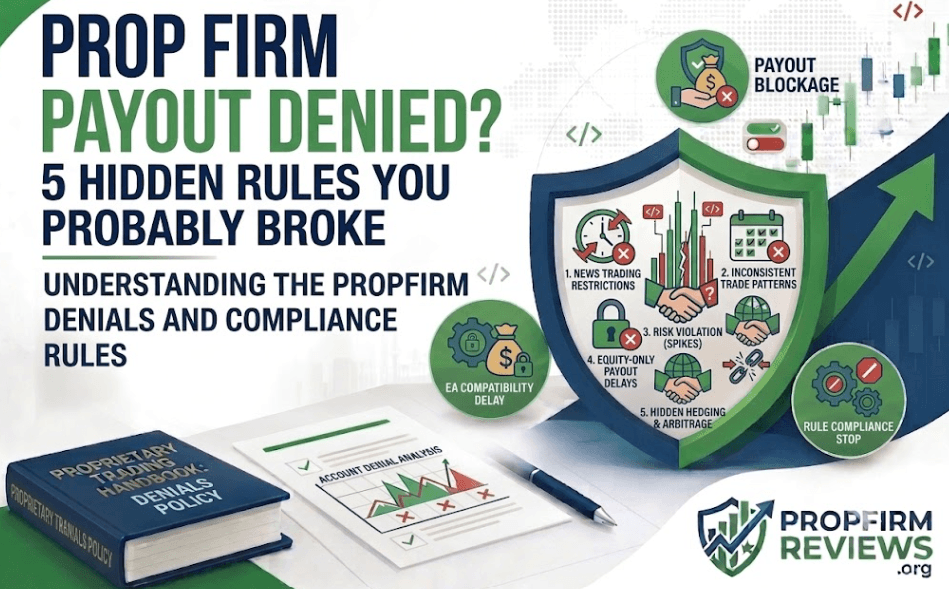
The moment you submit your first withdrawal request on a funded account is a big one.
You’ve cleared the evaluation targets, managed the daily trailing limits, and the payout finally feels within reach.
But for a surprising number of traders, this is exactly where things go sideways. Clicking “withdraw” doesn’t send cash straight to your wallet — it routes your account into a manual back-office review queue. That’s where a lot of traders run into a shocking prop firm payout denied notice.
A prop firm payout denial happens when the compliance or risk desk rejects a withdrawal after finding trade history anomalies during a manual audit. Automated systems already catch hard violations in real time, but the manual audit goes further — it reviews the account’s entire lifecycle looking for secondary issues like lot-size inconsistencies, toxic order flow (latency arbitrage, for example), IP location anomalies, and intentional slippage gaps. Find any of these, and the firm forfeits the profits and cancels the payout.
Here’s the thing to internalize early: passing the challenge is only phase one. Understanding exactly how the back-office audit queue works is what protects the money you’ve actually earned. For the wider context, our master guide to prop firm rules explained covers how this fits into the full evaluation framework.
The 3 Stages of a Manual Account Payout Audit
Click “Request Payout” and the platform freezes your trading access, then hands your complete raw data file over to an internal risk team.
Whether the firm pays out through Deel, Rise, or direct crypto, every withdrawal has to clear three sequential stages.
[ Withdrawal Request Clicked ] ➔ Trading Credentials Temporarily Frozen
                                           |
                ___________________________|___________________________
               |                           |                           |
     [ Phase 1: Tech Scan ]      [ Phase 2: Math Audit ]     [ Phase 3: Gateway Release ]
  Server Logs Parse Match-Keys   Lot Variance & Consistency  KYC / Sanction / Final AML
  for IP & Server-Side Frauds    Calculated via Risk Engine  Approval for Processor Payout
               |                           |                           |
 [ Fail ➔ Permanent Account Ban ] [ Fail ➔ Profit Deductions ] [ Pass ➔ Real Cash Dispatched ]
Phase 1: The Server-Side Automated Script Scan
Before any human looks at your performance, an automated script parses your log history for structural fraud. It scans for millisecond entry alignments across the broker database to check you’re not part of a signal syndicate or running a commercial bot. It also cross-checks your IP addresses to confirm no third-party service logged into your account — that alone can trigger a multiple accounts IP ban.
Phase 2: The Mathematical Consistency Audit
Clear the initial security filters, and the risk engine moves on to your mathematical uniformity — this is where the lot size consistency rule and single-day profit caps get enforced.
The engine calculates your exact volume average across every closed ticket. Catch one massive win on a high-impact news day that’s over 30% of your total gains, or notice you dropped to 0.01-lot micro-positions just to clear active trading days, and the account gets flagged for structural review.
Phase 3: The Liquidity Provider (LP) Slippage Reconciliation
Last step: the firm checks the quality of your fills against actual interbank market depth. On an A-Book setup, your execution gets reconciled against their institutional clearing broker. Find that your profits leaned heavily on exploiting latency gaps or thin spreads during daily transitions, and the firm will retroactively adjust your balance for slippage before approving anything.
Common Back-Office Compliance Actions
| Audit Discrepancy Found | Immediate Back-Office Action | Impact on Account Status | Profit Status |
|---|---|---|---|
| IP Address/Management Fraud | Hard Revocation of Credentials | Permanent Account Loss | 100% Forfeiture of Gains |
| Exceeding Single-Day Profit Cap | Payout Postponement / Extension | Account Kept Active | Excess Profit Voided |
| Lot-Size Variance Breach | Prop Firm Rule Violation Warning | Account Under Warning | Non-Compliant Trades Removed |
| Toxic Order Flow / Latency Arbitrage | Global Server Blacklisting | Account Termination | Complete Payout Denial |
The 30% Profit Cap and Scaling Trap
Here’s why so many genuinely profitable traders get stuck in the audit queue.
Say a trader runs a $100,000 funded account and nets $15,000 total over a two-week cycle. On Day 2, they catch a huge Nasdaq trend and lock in a single-day profit of $6,000. Every other day averages a steady $1,000.
During Phase 2, the risk desk applies the standard 30% consistency filter:
$$\text{Maximum Allowed Single-Day Allocation} = $15,000 \times 0.30 = $4,500$$
That $6,000 Day 2 win blows past the $4,500 threshold. The account usually doesn’t get banned for this — but the payout gets adjusted. Either the excess $1,500 gets deducted from the current withdrawal, or the trader has to keep trading until Day 2’s win drops below 30% of the total profit pool.
Strategic Game Plan: Passing the Payout Audit Seamlessly
Three habits that keep the audit process smooth:
Check your own history before requesting a withdrawal. Don’t submit blind. Export your trade history, calculate your own lot-size averages and single-day profit percentages, and if something’s out of bounds, trade a bit longer within your normal range to smooth it out before the compliance filters ever see it.
Don’t gamble on volatility near payout milestones. As your payout cycle winds down, resist the urge to swing for outsized positions or chase high-impact news. Keep your execution steady — a sudden change in volume right before a withdrawal request is exactly the kind of thing that triggers manual forensic review.
Document your IP and VPS setup. Trading from multiple locations or traveling often? Let support know ahead of time, and keep your execution on a reliable, dedicated VPS. A clean, consistent connection signature keeps automated fraud scanners from mistaking your normal sessions for something suspicious. Additionally, making sure you manually flatten positions on Friday afternoon prevents auto-liquidation slippage from impacting your records under strict prop firms weekend holding policies.
Strategic Verdict: Approaching Payouts Like a Professional
A sustainable career in prop trading means dropping the mindset of treating challenges like a quick gambling window.
These platforms run as tightly regulated risk management networks, using serious back-office analytics to protect their own capital.
Align your daily execution with both the automated and manual compliance layers, and your funded status stays insulated from systemic failures — letting your edge clear review cleanly and turn into predictable, long-term withdrawals. For more, check our deep-dive on the lot-size consistency rule and profit caps or our guide on equity vs balance daily reset mechanics.