
Prop Firm Prohibited Strategies & Structural Arbitrage: Surviving the Fraud Detection Filters
Retail prop trading has changed a lot in a short time.
Passing a challenge and staying above your equity floor used to be most of the battle. It isn’t anymore.
Back-office risk infrastructure has gotten seriously sophisticated. Today, the bigger threat to a funded account often isn’t a bad trading day — it’s tripping an automated flag for prop firm prohibited strategies.
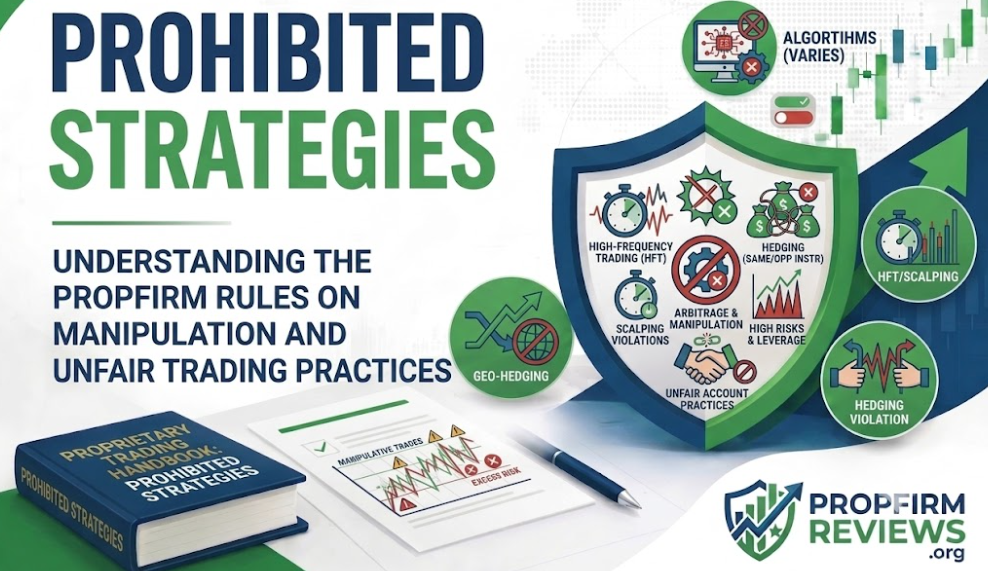
Prop firm prohibited strategies are specific execution styles, latency manipulation tricks, or structural exploits that platforms ban to protect themselves from toxic order flow and system arbitrage. That list includes latency arbitrage, multi-account reverse hedging, high-frequency tick-scalping, news straddling, and aggressive martingale grids. When a server-side risk engine picks up on one of these mechanical signatures, it triggers either an instant account termination or a permanent payout denial during audit.
Here’s the part most retail traders don’t realize: some strategies that get promoted heavily on social media are treated as outright structural fraud by institutional liquidity networks. Knowing how server bridges actually define these patterns is what protects your capital. For the bigger picture, our master guide to prop firm rules explained covers how this fits into the wider compliance framework.
Technical Deep-Dive: What is “Toxic Order Flow”?
To see why platforms hunt these strategies so aggressively, you have to look past the retail interface and into how institutional clearing actually works.
Prop firms run on two basic models: simulated execution (B-Book), where the firm pays winners out of the entry fee pool, and live market routing (A-Book), where orders go straight to an external liquidity provider through a financial bridge.
[ Retail Trader Execution ] ➔ Sent via Bridge (OneZero / PrimeXM)
                                         |
               __________________________|__________________________
              |                                                     |
    [ A-Book Routing Path ]                               [ B-Book Simulation Path ]
 Trades Matched with Institutional LPs                  Virtual Matching Engine Analyzes Book
              |                                                     |
  (Arbitrage / High-Frequency Flares                    (Exploitative Data Feed Latency
   Create Asymmetric Risk Slippage)                      Extracts Risk-Free Virtual Cash)
              |                                                     |
[ LP Revokes Liquidity / Demands Ban ]                 [ Firm Triggers Hard Breach Flag ]
In an A-Book setup, high-frequency scripts that spam sudden execution spikes force the LP to fill at a disadvantage, since market depth is limited. That creates asymmetric slippage — and it damages the firm’s relationship with its own clearing network.
In a B-Book setup, some traders exploit tiny delays or discrepancies between data feeds to pull essentially risk-free money off the firm’s own balance sheet. To catch this, platforms use bridge analytics tools like PrimeXM or OneZero to spot and block these patterns instantly.
The Master Matrix of Banned Architectural Strategies
Risk engines don’t care about intent. They just parse log files for repeating mathematical patterns in your order tickets. Fall into any of these seven categories, and you’re looking at a violation warning at best, an instant ban at worst.
| Prohibited Strategy Type | Technical Mechanism | Detection Blueprint | Violation Severity |
|---|---|---|---|
| Latency Arbitrage | Exploits millisecond price delays between lagging broker feeds | Execution speed consistently under 200ms from tick receipt | High (Instant Permanent Ban) |
| Reverse Hedging | Opening opposite maximum-leverage positions across two accounts | Identical execution timestamps down to the millisecond across different IDs | High (Forfeiture of all fees) |
| Tick Scalping / High Frequency | Holding trades for fractions of a second to harvest micro-pips | Average trade duration under 3 to 5 seconds across 40%+ of logs | Medium (Profit deduction) |
| News Straddling | Placing buy-stop and sell-stop pending orders seconds before macro events | Pending orders modified or filled within 15 seconds of a red-folder release | Medium (Payout adjustment) |
| Account Churning / Syndicates | Multiple users utilizing identical master copier networks | Multi-account execution tracking matching identical server IPs | High (Global System Ban) |
| Toxic Martingale / Grid Systems | Automated scaling of positions into a loss without risk parameters | Geometric lot-size expansion matching zero stop-loss protocol | Medium (Evaluation fail) |
| High-Frequency EA Passing Loops | Using aggressive HFT algorithms to game demo evaluations | Exploitation of simulated liquidity depth gaps on MT4/MT5 | High (Funded phase denial) |
Technical Breakdowns of the Core Forbidden Tactics
Let’s get into the actual technical signatures compliance scripts scan for during a live session.
1. Latency Arbitrage (Feed Exploitation)
Every broker streams prices through a data feed wrapper. If a prop firm’s server hits even a microsecond bottleneck, its feed can lag a few pips behind the primary institutional spot market.
Latency arbitrage bots connect directly to an ultra-fast raw feed — something like LMAX or Saxo — and compare it against the prop firm’s terminal in real time. When the fast feed spikes, the bot buys on the lagging prop firm feed, essentially knowing with certainty the price has to tick up within the next 50 milliseconds.
Firms run scripts that measure the exact gap between your order submission and the global timestamp of that market quote. Consistently fill orders at prices that have already moved on the interbank network, and the system flags it as system exploitation.
2. Cross-Account Reverse Hedging (The Risk-Free Loophole)
This one shows up a lot with retail syndicates trying to game the evaluation phase. Someone buys two evaluation accounts. On Account A, they open a max-leverage long on Nasdaq right before a big data release. On Account B, an identical max-leverage short at the exact same price.
                    [ High-Impact Macro Economic Event ]
                                     |
           __________________________|__________________________
          |                                                     |
 [ Account A: Max Long ]                               [ Account B: Max Short ]
Market Spikes Upward +200 Pips                         Market Spikes Upward +200 Pips
          |                                                     |
 (Account Hits Profit Target)                          (Account Hits Max Drawdown Limit)
          |                                                     |
 [ CLEAR COMPLIANCE PASS ]                             [ INSTANT HARD BREACH BAN ]
On the surface, it just looks like good risk management on one account. To a matching engine, it’s zero-risk gambling — the trader used the firm’s own capital to erase their personal market risk entirely.
Fraud compliance engines run cross-account correlation checks. If one account hits its profit target the same millisecond another account with an inverted position drops below its max trailing drawdown, both get flagged for syndication fraud.
3. Account Churning & Master-Copier Syndicates
Some traders try to scale by buying multiple accounts under different names and linking them to a single local trade copier. Copying trades across your own accounts is usually fine under certain rules — copying a public master signal is not.
When a signal provider sells a copy-trading link to 500 traders, all 500 accounts fire the exact same entry at the exact same millisecond.
That creates a massive, unhedged cluster of identical risk on the firm’s book, the engine sees what looks like an unauthorized $50 million position landing all at once.
The compliance desk will typically deny payouts across every account tied to that execution signature.
Executing orders manually during macro releases can also land you in structural trouble if you don’t know the exact constraints enforced by prop firms that allow news trading environments.
Grid Trading & Martingale Risk Templates
Grid systems and martingale strategies are common among algorithmic retail traders. A martingale system doubles position size every time a trade moves into a loss — 1 lot, 2 lots, 4 lots, 8 lots — betting the market has to reverse eventually.
It can produce a smooth equity curve for a while on a standard retail account. On a prop firm’s grid trading rules infrastructure, it interacts badly.
[ Trade 1: 1 Lot Long ] ➔ Market Drops 20 Pips (Floating Loss)
                                 |
[ Trade 2: 2 Lots Long ] ➔ Market Drops Another 20 Pips (Floating Loss Increases)
                                 |
[ Trade 3: 4 Lots Long ] ➔ Market Drops Another 20 Pips (Exponential Risk Spike)
                                 |
[ Server Script Intervenes ] ➔ Margin Allocation Exceeds Risk Safety Profiles
                                 |
[ Hard Compliance Breach Flagged ] ➔ Account Terminated Before Market Reversal
Risk models evaluate risk per asset block. Spot a geometric lot-size expansion paired with a growing floating drawdown, and the system reads it as toxic layer loading.
The account usually gets shut down before the martingale sequence can fully expose the firm’s capital pool to a margin call event.
Running these layouts via open-source marketplace automated tools often runs directly into the compliance filters configured by prop firms that allow eas platforms.
Strategic Game Plan: Ensuring Absolute Execution Cleanliness
Three habits keep your account clean through audit review:
Keep a healthy average trade duration. If your strategy involves quick scalp entries, keep your holding times comfortably above 10 to 15 seconds. Avoid clicker scripts or bots that dump hundreds of micro-orders into a single session.
Use unique, non-commercial algorithmic code. Running an EA straight out of the box on public settings is risky. Modify the internal parameters, add randomized execution delays, customize your take-profit and stop-loss spreads. Changing your execution fingerprint keeps you from matching a known commercial bot’s risk profile.
Keep clear execution autonomy. If you run multiple accounts or trade near a colleague on the same network, put each setup on its own independent VPS. That keeps security scripts from flagging you for multi-account IP syndication.
Strategic Verdict: Building an Unshakable Trading Track Record
A sustainable career in prop trading means moving past the speculative retail mindset entirely.
These platforms aren’t basic brokers collecting spread fees — they’re structured capital allocation networks that come down hard on anything resembling system exploitation or asymmetric arbitrage.
Match your setup to how the institutional bridges actually operate, and you take systemic account failures off the table. That’s what lets your edge turn into consistent, long-term withdrawals instead of a flagged account. For more, check our deep-dive on equity vs balance drawdown mechanics or our full breakdown of weekend holding and swing trading policies.