
Prop Firm News Restrictions: The Definitive Trader Compliance Manual
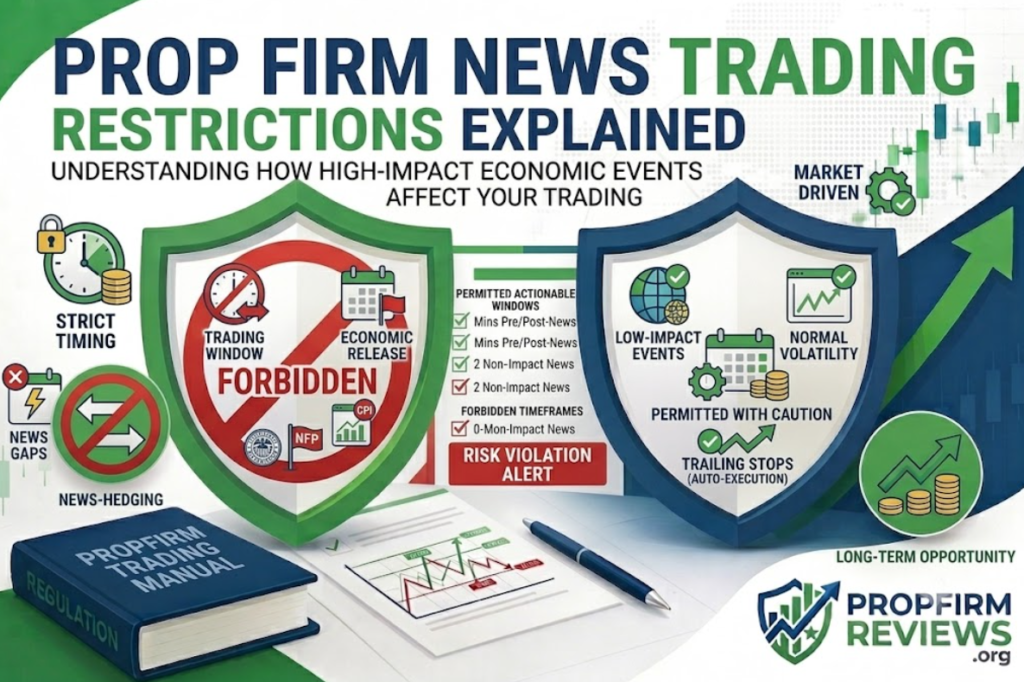
High-impact news releases are where the real volatility lives. CPI prints, NFP, FOMC decisions — these are the moments where the biggest moves in the market happen in seconds.
For a retail prop trader, though, those same seconds are a minefield. Automated risk desks lock these windows down hard, because a single trader catching a huge slippage-fueled fill can expose the firm’s whole liquidity pool.
That’s exactly why prop firm news restrictions exist, not to stop you from trading well, but to stop the platform’s own execution infrastructure from getting blindsided. Before deploying any capital into these high-volatility events, reviewing how these guidelines operate within the overall dashboard parameters is essential.
For the bigger picture of how this fits into everything else, our master guide to prop firm rules explained covers the full framework.
A prop firm news trading restriction is an automated rule that blocks opening or closing positions inside a specific time window, usually 2 minutes before and 2 minutes after a high-impact macro event like CPI, NFP, or an FOMC rate decision.
Break that window and you’re looking at one of two outcomes: a soft breach, where the profit from that trade gets stripped out, or a hard breach, where the account is terminated on the spot.
If you want to trade around these events without losing your funded status, you need to know exactly which platforms are watching the clock — and how tightly. Here’s our verified breakdown of how the major firms actually handle it.
2026 Master Directory: News Rules by Firm
Every firm treats this differently, largely depending on whether your orders route through a simulated demo feed or hit a live institutional matching engine.
| Proprietary Trading Platform | Restricted Time Window | Violation Consequence | High-Impact Events Monitored |
| FTMO (Standard Accounts) | 2 Minutes Before / 2 Minutes After | Profit Deduction (Soft Breach) | CPI, NFP, FOMC, ECB Decisions |
| FTMO (Swing Accounts) | No Restrictions | No Violation | None |
| Topstep (Futures) | No Flat Restriction (Must follow CME Price Limits) | Extreme Slippage Warning | All CME Core Data Releases |
| FundedNext (Evaluation) | 2 Minutes Before / 2 Minutes After | Account Termination (Hard Breach) | Red Folder Events (ForexFactory) |
| Velotrade | No Restrictions | No Violation | None |
| 5%ers | 2 Minutes Before / 2 Minutes After | Profit Forfeiture / Warning | Major Central Bank Core Releases |
Worth noting: this table can shift firm to firm, and firms occasionally update their restriction lists mid-year without a big announcement. If news trading is central to your strategy, it’s worth re-checking a firm’s live rulebook every few months rather than trusting a bookmark from last year.
Technical Mechanics: How the Lock-Out Window Triggers
The risk scripts running behind platforms like MetaTrader Admin, Rithmic, or Tradovate don’t care whether a human clicked the button or a bot fired the order. All that matters to the engine is the execution timestamp logged on the server.
1. The Execution Blackout
Say a firm runs a strict “2-minute restriction” rule. For an event scheduled at 8:30 AM EST — the U.S. CPI release, for example, the blackout window runs from 8:28:00 AM EST to 8:32:00 AM EST.
-
Prohibited during that window: opening a new market order, triggering a pending limit or stop order, or closing an existing open position.
-
Allowed during that window: simply holding a position you opened before 8:28:00 AM EST — as long as your stop-loss or take-profit doesn’t actually get triggered inside those 240 seconds.
2. The Stop-Loss / Take-Profit Trap
This is the part that quietly generates a huge share of prop firm rule violation warning notices. Say you open a swing trade at 8:00 AM EST with a stop-loss set. The 8:30 AM CPI print causes a violent gap, and your stop-loss gets blown through right inside the 8:28–8:32 window.
A lot of firms will still classify that as a hard breach. The risk engine doesn’t check your intent — it just sees a position closed during restricted hours, and treats it exactly the same as if you’d closed it manually. Certain aggressive styles that depend on exploiting these latency fills are grouped under prop firm prohibited strategies and will face immediate profit forfeiture during payouts.
The Core Macro Indicators to Monitor
Keeping your funded status intact means keeping your economic calendar synced with your platform’s specific tracking rules. Across the industry, “Red Folder” events on trackers like ForexFactory are the universal benchmark. These three matter most:
-
CPI (Consumer Price Index): Reshapes interest rate expectations almost instantly.
-
NFP (Non-Farm Payrolls): Drives massive institutional volume and sharp liquidity gaps in USD pairs and equity indices.
-
FOMC (Federal Open Market Committee Rate Decisions): Produces multi-directional whipsaws that can blow retail spreads out far wider than normal.
A smaller but often-missed one worth adding to that list: PMI (Purchasing Managers’ Index) releases, particularly the ISM Manufacturing print. It doesn’t get the same headlines as NFP, but it regularly moves USD pairs enough to trip the same 2-minute restriction windows — and it’s easy to miss on a calendar if you’re only filtering for “major” events.
Strategic Verdict: Choosing Your Infrastructure
Your trading style should really be what decides your platform, not the other way around.
If you’re a news momentum trader, standard evaluation accounts aren’t built for you. Look at specialized setups like FTMO Swing accounts, or move to a multi-asset platform without a restriction window.
Check our updated guide to prop firms that allow news trading so you keep 100% of what you earn on those moves. Furthermore, be aware that platforms offering hft prop firms loophole parameters to pass challenges often enforce massive structural boundaries and lower leverage rules during the subsequent live master phases.
If you’re a daytime swing trader: build in buffer zones. Flatten positions or widen your stop-loss well ahead of the 2-minute blackout, so latency and erratic spreads during the release can’t touch your open risk.
Tired of Complex Execution Blackout Windows?
If your edge depends on trading straight through high-impact data, a strict blackout window isn’t going to work for you. Our unbiased Velotrade review looks at how their zero-restriction policy actually holds up in live conditions, and our breakdown of equity vs balance drawdown mechanics can help you tighten up your daily reset strategy alongside it.